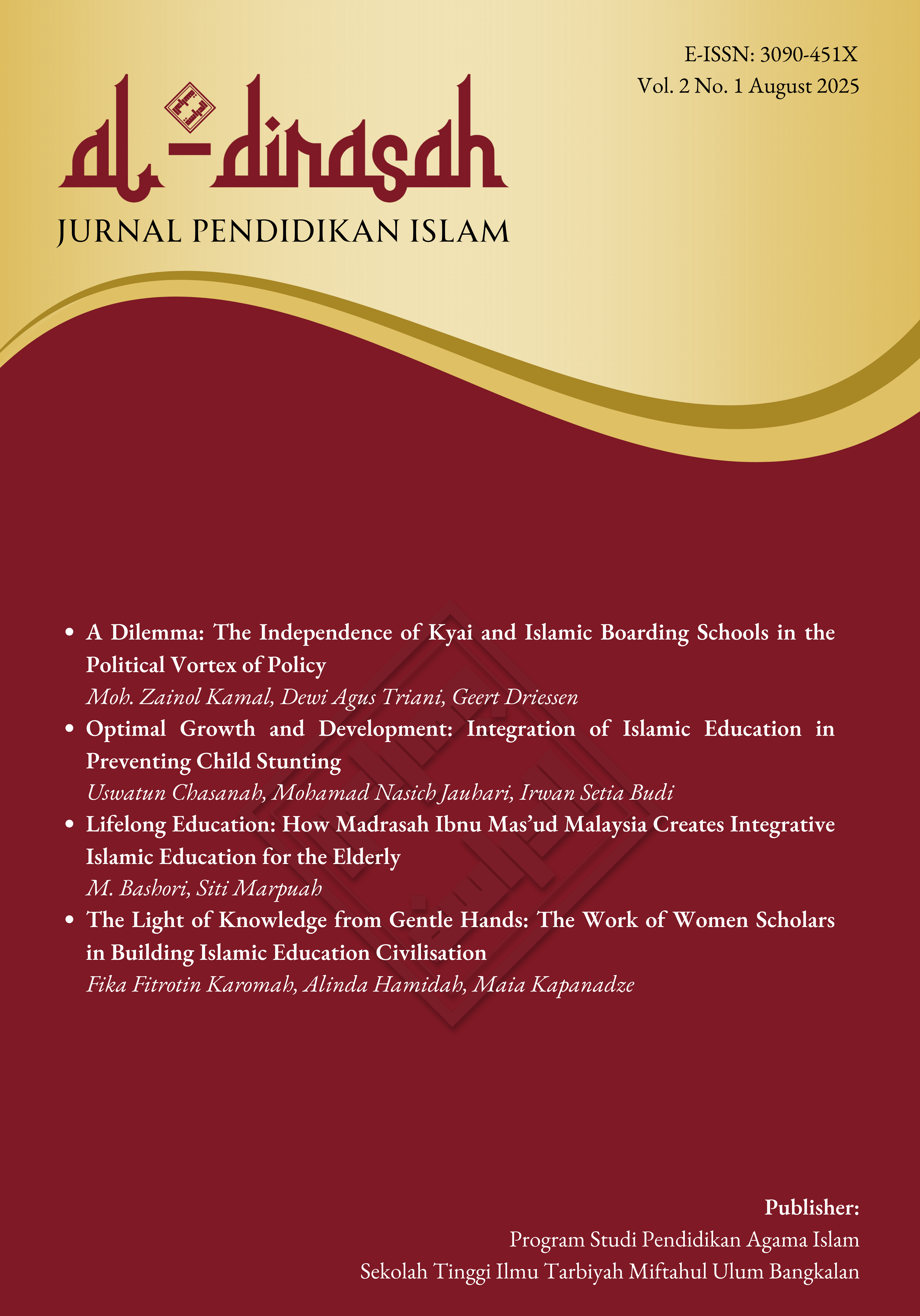
A Dilemma: The Independence of Kyai and Islamic Boarding Schools in the Political Vortex of Policy
DOI:
https://doi.org/10.47731/aldirasah.v2n1.2025.1Keywords:
Kyai, Islamic boarding schools, policy, politicsAbstract
This study is aimed at exploring the independence of kiai as spiritual leaders in Islamic boarding schools in formulating policies in the field of education. In analyzing these policies, this research focuses on the development of teaching and the application of the "Single Principle of Pancasila" in Indonesian educational institutions, the dynamics of Islamic boarding schools policies that resulted in the birth of Law No. 18 of 2019, and the negative aspects of the politicization of religion that have an impact on education policy. This study adopts a qualitative approach through case studies in two Islamic boarding schools located in East Java as the subject of the study. Primary data is obtained through observation and interview activities, while secondary data is sourced from literature such as laws and regulations, scientific publications (journals), books, and other references. Data collection methods include observation, in-depth semi-structured interviews, and documentation (document review). Data analysis is carried out with a qualitative approach through the stages of data condensation, data presentation, and conclusion formulation. The findings of the study indicate that laws and regulations give power to Islamic boarding schools and kiai to build their institutions based on the needs of the community, traditional values, and the progress of the times. Although the autonomy of the kiai substantially affects the direction of the development of the Islamic boarding schools, this factor is not the only determinant of the characteristics of the Islamic boarding schools. The regulations emphasize the importance of implementing modern teaching methodologies, curriculum transformation, and facility development, and encourage kiai to abandon rigid and authoritarian approaches.
Downloads
Published
Issue
Section
License
Copyright (c) 2025 Al-Dirasah: Jurnal Pendidikan Islam

This work is licensed under a Creative Commons Attribution-NonCommercial 4.0 International License.